Swingweight measures resistance to rotation about the handle. It is quoted in kg·cm² and printed without units, as a three-figure number somewhere around 300. Two frames of the same weight can differ by twenty points of swingweight, and those twenty points are what your arm actually notices.
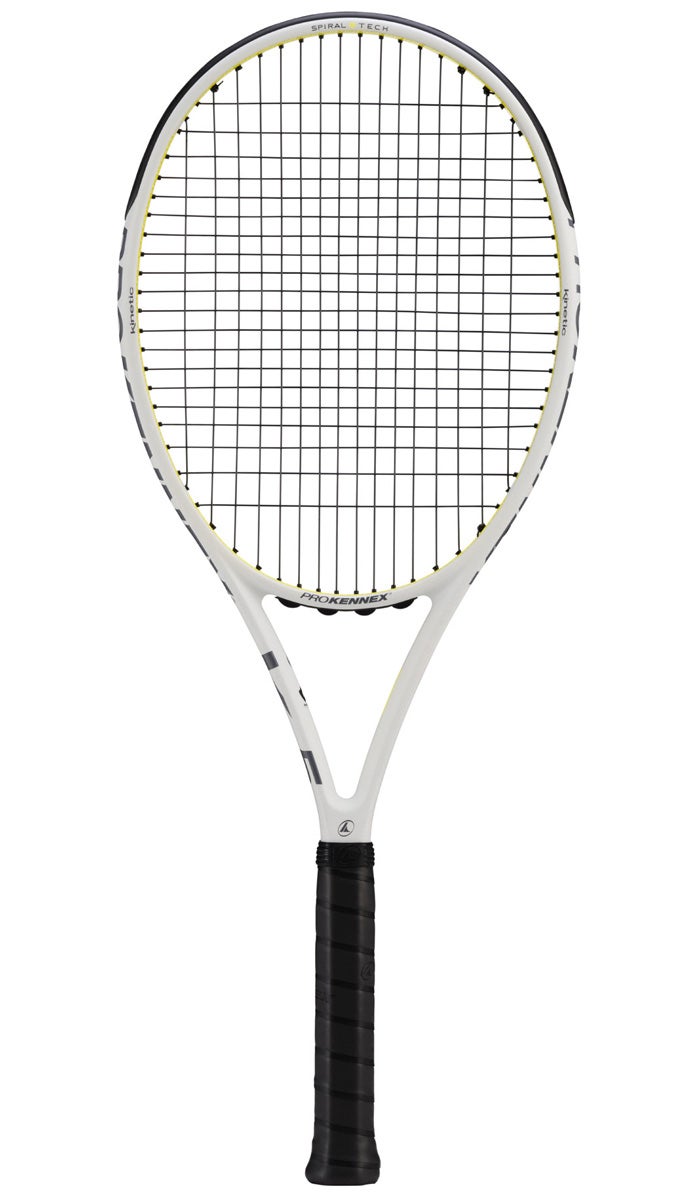
In the 65 frames we hold a swingweight for, the figures run from 286 to 332, median 321. The lowest is the ProKennex Ki 5 (260 g) 2022 at 286; the highest is the ProKennex Ki Q+ 5 Pro (310 g) at 332. A useful rule of thumb from those numbers: under about 310 is quick and forgiving to swing, 310–325 is the club standard, and above 325 is a frame that rewards a full, early preparation and punishes a late one.
Why it is a better number than weight. Swingweight combines how much mass a racquet has with how far that mass sits from your hand — so it folds weight and balance into one figure. If you can only look at one specification before buying, this is the one that tells you most about how the frame will feel in the third game of the first set.
Higher swingweight gives you plough-through: the racquet keeps its line against a heavy ball instead of being knocked back. Lower swingweight gives you racquet-head speed, which is where topspin comes from, and it lets you recover between shots. Neither is better; they are opposite ends of the same trade.
An honest caveat about our own figure. Swingweight has to be measured on a machine, and manufacturers publish it far less consistently than weight or head size — which is why we hold it for 65 frames rather than all 248. Where we do not have it, the product page says so rather than estimating one.