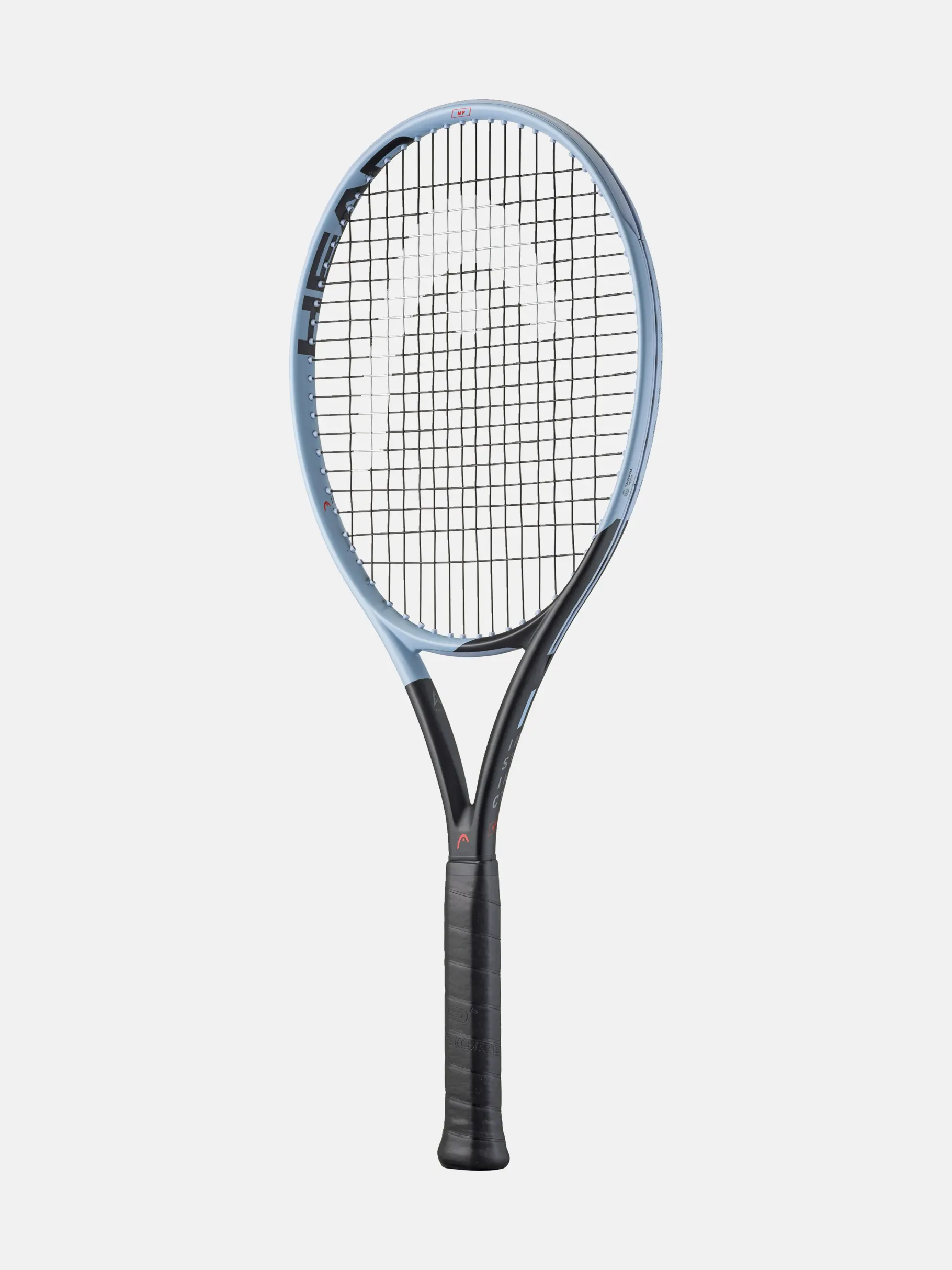
A modern adult racquet weighs between 230 and 330 grams unstrung. Across the 248 frames in our catalogue that carry a weight, the median is 300 g — which is why 300 g is the number everybody repeats. It is a real centre of gravity for the market, not a rule.
The catalogue divides fairly cleanly into four bands. 30 frames come in under 270 g, 70 sit between 270 and 289 g, 118 between 290 and 309 g, and 30 are 310 g or heavier. The lightest we hold is the Head Instinct PWR 115 2025 at 230 g; the heaviest is the Head Prestige Classic 2.0 at 330 g.
What the bands are for, in one line each. Under 270 g is a junior frame or an adult racquet built for someone who cannot yet swing a heavy one through the ball — easy to get round, punished by pace. 270 to 289 g is the improver's band: enough mass to hold its line, light enough to keep swinging in the third set. 290 to 309 g is where most club players who play weekly end up. 310 g and above is a competitive frame, and it asks for technique before it gives anything back.
Two things the number does not tell you. First, it is the unstrung weight: a string bed and an overgrip add roughly 15 to 20 g, so a 300 g frame arrives on court near 318 g. Second, and more importantly, weight is not how heavy a racquet feels. Where the mass sits decides that — see the balance and swingweight pieces — and a head-heavy 285 g frame can feel far more of a handful than an even-balance 305 g one.
So the honest answer to the question is: 230 to 330 g, with most of the market at 300 g, and the figure alone is not enough to choose on. If you are picking between two frames, weight narrows the field; balance and swingweight decide it.